
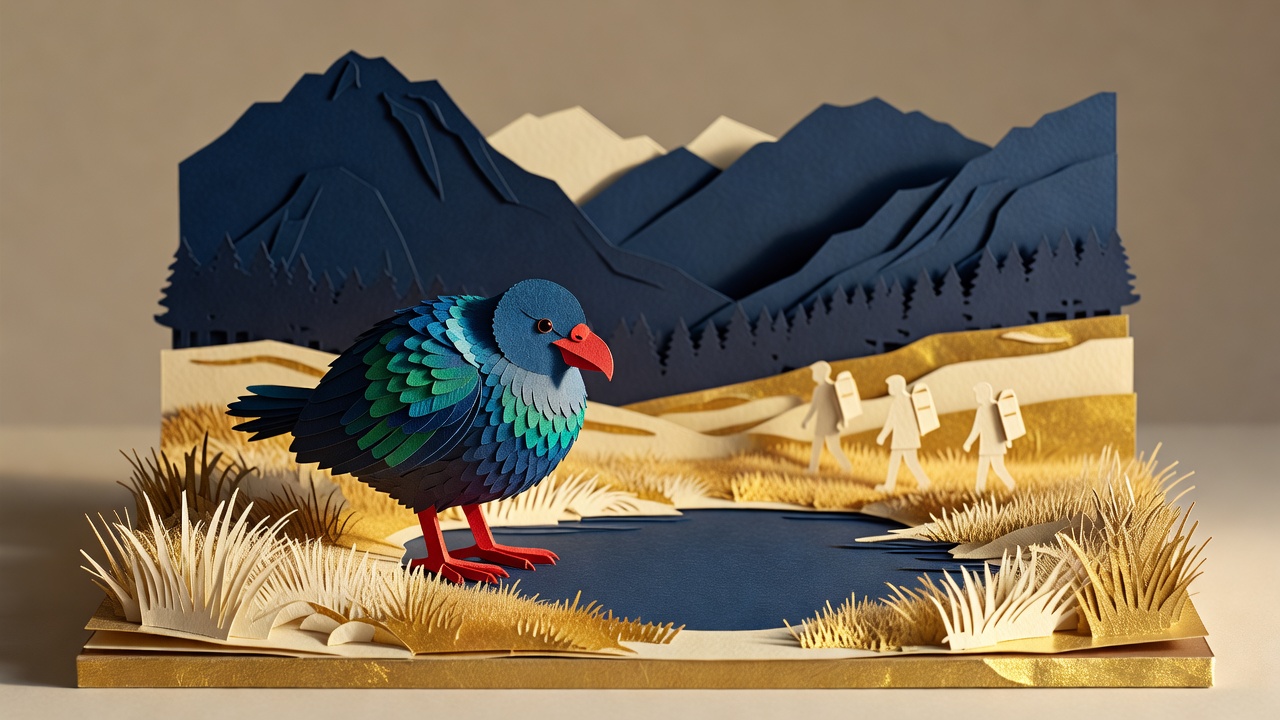
- 1The rediscovery party was led by Invercargill doctor Geoffrey Orbell and found the birds at what is now called Lake Orbell.
- 2DOC says the Murchison Mountains cover more than 50 thousand hectares, across the lake from Te Anau.
- 3DOC says takahē weigh between 2.3 and 3.8 kg and cannot fly.
- 4DOC lists Punanga Manu o Te Anau, the Te Anau Bird Sanctuary on the shores of Lake Te Anau, as a public place to see takahē.
Takahē are flightless birds that New Zealand had written off as extinct. On 20 November 1948, Invercargill doctor Geoffrey Orbell led a small party, including Neil McCrostie, Rex Watson and Joan Telfer, deep into the remote Murchison Mountains of Fiordland National Park. They had followed strange bird calls and footprints in the tussock, and at what is now called Lake Orbell they found a living takahē, half a metre tall and bright iridescent blue and green. We read the Department of Conservation's account of the rediscovery and its takahē pages on Monday 23 November 2026, NZ time, and every fact here comes from them.
DOC says the Murchison Mountains, known as Te Puhi-a-noa, sit in Fiordland National Park across the lake from Te Anau and cover more than 50 thousand hectares of tussock and beech clothed mountains and valleys. Because the takahē were rediscovered there, DOC calls the area the origin of all known takahē alive today. The rediscovery launched what DOC describes as New Zealand's longest running endangered species programme.
The bird itself is hard to miss. DOC says takahē weigh between 2.3 and 3.8 kg, have stout red legs and a large red beak, and use their wings only for display or as a show of aggression. They are a distant relative of the pūkeko, but much larger and more brightly coloured.
The easiest place to see one on a Fiordland trip is Punanga Manu o Te Anau, the Te Anau Bird Sanctuary, which DOC says is on the shores of Lake Te Anau and open to the public. Our Te Anau things to do guide covers the sanctuary and the rest of a day in town.
Takahē are also back near Glenorchy. DOC says the birds were returned to the Upper Whakatipu in 2023, on the Greenstone Valley floor, and to the nearby Rees Valley in 2025, and that walkers on the Greenstone and Caples, Rees-Dart and Routeburn tracks might see one. Our Glenorchy tours guide helps you plan the trip to the head of the lake.