
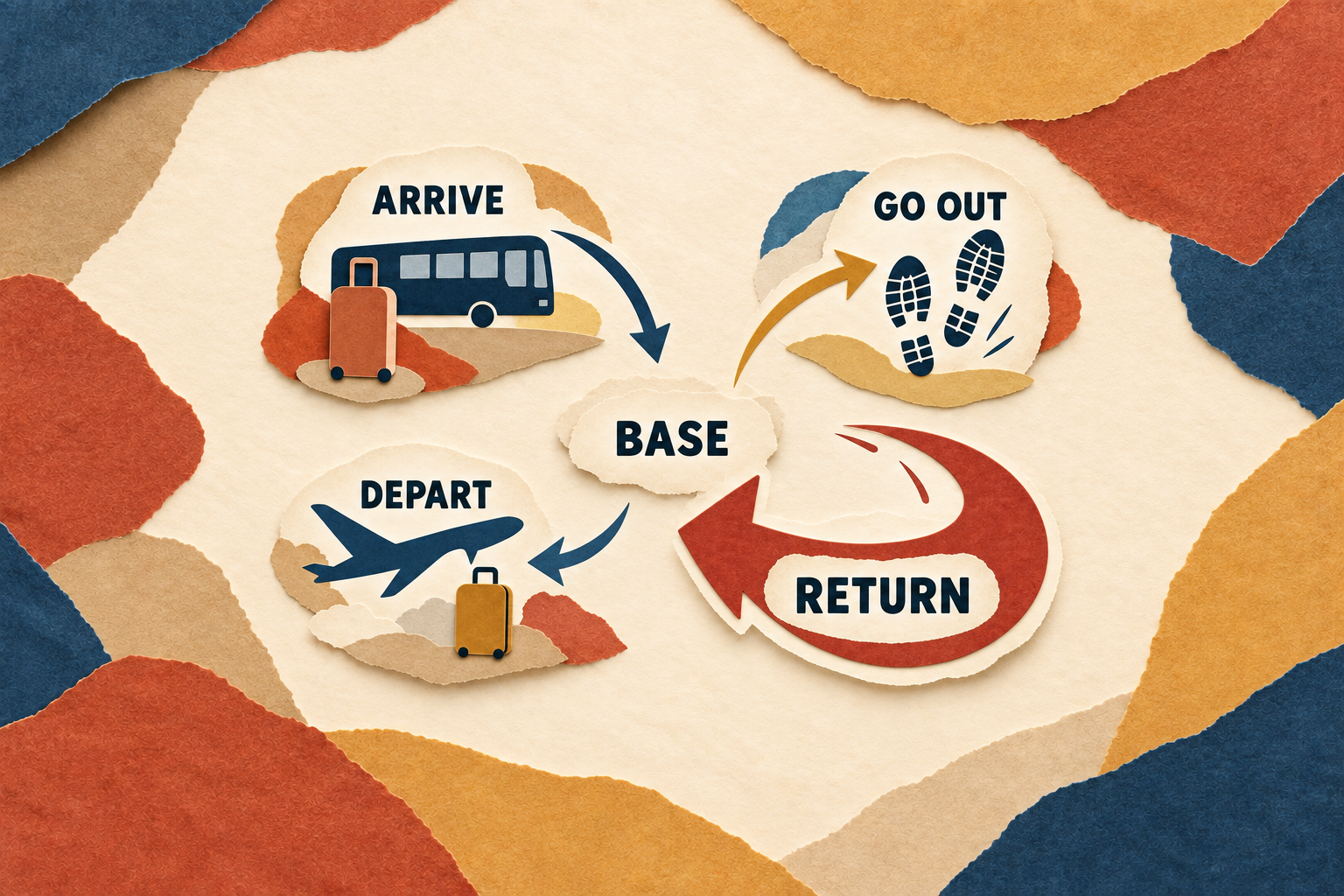
- 1A full Queenstown stay can work without a car when your base, daily route and return plan fit the current public network or a pre-booked transfer.
- 2Central Queenstown and Frankton give the clearest starting points for airport arrival, local buses and onward connections; outer bases need a route by route check.
- 3Treat luggage as a transport decision. ORC says suitcases on buses depend on available room and driver discretion, while the ferry recommends one item per person that you can carry yourself.
- 4Before booking, test arrival, each outward trip, each return trip and departure against current official information, then keep the existing Airport guide for the airport handover.
01 / Short answer
stay without a car by planning the return first
A car free Queenstown stay is not one transport choice. It is a chain of handovers: airport to accommodation, accommodation to the day's first stop, the return from that plan, and accommodation back to the airport. The official airport pages list public buses, taxis, rideshare, shuttles and transfers. Orbus lists Queenstown routes through Frankton and downtown Queenstown. The useful decision is the base and routine that still works when you are carrying bags or returning later than planned.
02 / Choose the base
Match your address to the network
| Base pattern | Why it can work | What to prove before booking |
|---|---|---|
| Central Queenstown | Orbus identifies downtown Queenstown on Stanley Street as a network connection point, and the ferry service includes Queenstown Bay. | Find the actual stop for the accommodation, then test the return after every planned day. |
| Frankton and the airport side | The airport says public buses connect the airport with Frankton and Queenstown, with onward local routes through the Frankton interchange. | Check the accommodation's walk to the stop, the route for each day and the airport handover with luggage. |
| Arrowtown, Jacks Point or Lake Hayes Estate | The ORC route list includes services connecting these areas with Frankton or Queenstown, but they are not one interchangeable route. | Plan the outward and return leg separately, including the last suitable current service and a fallback. |
| Kelvin Heights or a ferry linked base | Orbus includes a ferry in the Queenstown network, and the operator lists Queenstown Bay, Frankton Marina, Bayview and Hilton stops. | Check the exact wharf, demand stop rule, luggage capacity, accessibility and weather dependent conditions. |
03 / The full stay test
Four handovers to solve before you commit
A plan is car free only when every necessary handover has a named option and a fallback.
Arrival
Get from the terminal to the door
Outward
Leave the base on the current route
Return
Plan the way back before leaving
Departure
Carry the airport plan through the last day
04 / Luggage decisions
Choose the mode around what you can carry
| Mode | Useful when | Luggage check |
|---|---|---|
| Orbus bus | Your bags are manageable and the route is confirmed for the actual trip. | ORC says suitcases are accepted only if there is room and at driver discretion. Large items that do not fit between seats are unsuitable. |
| Orbus ferry | Your base or day plan matches the listed wharves and the current service fits. | The operator says you must carry your own luggage and recommends one item each because capacity is limited. |
| Taxi or rideshare | You need a direct airport or accommodation handover, especially with several bags. | The airport says these services can suit luggage, but the actual vehicle, pickup zone and fare method still need confirmation. |
| Pre booked shuttle or transfer | A group needs a named pickup or door to door arrival and departure plan. | The airport says services may be shared or private and may suit extra luggage. Confirm the provider's vehicle, meeting point and change terms. |
05 / Booking check
Run the whole stay on paper
- 01Pin the real base
Use the accommodation address, not only the suburb or marketing name, and identify the nearest current stop or wharf.
- 02Test the arrival
Compare the airport options with your arrival time, luggage, check in instructions and the distance from the stop to the door.
- 03Test each outward leg
For every planned area, use the current Orbus planner or the current ferry information to check the correct route, stop and day.
- 04Test each return leg
Write down where you return from and how you get back to the base. Do not assume the outward route is the best return route.
- 05Test the last day
Match the current airport transfer and airline advice to bag drop, screening, assistance and the time you need to leave the accommodation.
06 / The honest tradeoff
choose less driving, more route discipline
Going without a car can simplify the stay when your base is well connected and your plans return to that network. It can also add waiting, transfers, luggage handling and a need to check alerts. If the stay depends on several outer areas, compare the cost and flexibility of a pre booked day transfer or an existing tour with the work of coordinating each public return. Never infer live availability, pickup coverage or a guaranteed return from a tour page alone.
07 / Before you pay
The car free confirmation list
Save these answers with the booking details so the plan survives the first and last day.
- Address
Do you have the full accommodation address and check in instructions?
- Stop
Which current bus stop or wharf serves the actual address, and is there a final walk or transfer?
- Bags
Can every traveller carry the luggage through the selected mode, including a possible wait or transfer?
- Return
What is the current return route after each planned day, and what is the fallback if it no longer fits?
- Departure
What does the airline recommend, and when must the group leave the accommodation to complete every handover?